

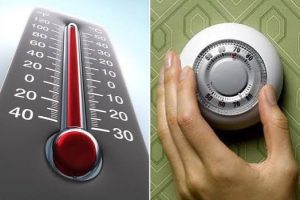
It’s fall here in Michigan, which means one thing. The weather has absolutely no idea what it wants to do. One day it’s 75 degrees and sunny. The next morning it’s 40 degrees and I’m wondering if it’s time to turn on the furnace. Lately, I’ve noticed myself adjusting the thermostat much more than usual.
Turning up the heat in the morning. Turning it back down in the afternoon. Occasionally I’m wondering whether I should be running the heat or the air conditioning.
Welcome to fall in Michigan!
Then something hit me. As a leader, are you a thermometer or a thermostat?
Think about that for a minute. A thermometer has one job. It measures the temperature. It tells you when things are getting too hot, when they’re cooling down, and when everything seems to be running just about right.
A thermostat, on the other hand, does something very different. It actually changes the temperature. I think there’s a pretty powerful leadership lesson in that distinction.
First, Learn to Read the Temperature
When you first step into a leadership role, one of the most important skills you develop is learning how to read the room. You pay attention to what’s happening with your team, your organization, and your business. You notice when people are energized and engaged. You recognize when morale is slipping. You sense when the tension is building between team members or when people are becoming overwhelmed by the demands of the business.
Essentially, you’re learning how to take the temperature, and that’s important.
In fact, I’d argue that if you can’t accurately read the temperature of your team, you’re probably going to struggle as a leader.
Here’s where things get interesting, because reading the temperature is only half the job.
Great Leaders Learn to Change the Temperature
Once you’ve learned how to recognize what’s happening around you, the next step is learning how to influence it. That’s when you stop being just a thermometer and start becoming a thermostat.
Let me give you a few examples.
When the Team Is Running Hot
You’ve got a major deadline approaching. Everyone’s working hard. People are putting in extra hours. Stress is building, patience is getting shorter, and you’re starting to notice frustration between team members.
A thermometer recognizes the problem.“Wow, everybody seems pretty stressed out right now.”
A thermostat does something about it.
Maybe you bring the team together, clarify priorities, eliminate unnecessary work, or simply give people permission to step back and catch their breath. You don’t necessarily remove the pressure. You help people manage it more effectively.
When the Team Is Running Cold
You’ve got a team that’s become a little too comfortable. They’re getting the work done, but there’s not much energy. Nobody’s bringing new ideas to the table. People are going through the motions, and the attitude seems to be, “This is the way we’ve always done it.”
A thermometer notices the lack of engagement and starts asking questions.
What are we capable of that we’re not currently doing?
Where can we challenge ourselves?
What opportunities are we missing?
Maybe you set a new goal, create an opportunity for someone to lead a project, or invest some time coaching and developing people.
You turn up the temperature by creating energy, opportunity, and a little healthy discomfort.
When Emotions Are Taking Over
We’ve all been in meetings where things start to get a little heated. Someone challenges an idea. Another person gets defensive. Suddenly, what started as a productive conversation turns into a battle over who’s right and who’s wrong.
A thermometer recognizes that the temperature is rising.
A thermostat knows how to bring it back down.
Maybe you slow the conversation. Ask a better question. Acknowledge the frustration. Or remind everyone of the outcome you’re trying to accomplish together.
Sometimes the most important thing you can do is manage your own emotional temperature. Because here’s something I’ve learned after years of coaching leaders.
Your team will often take its emotional cues from you.
If you’re constantly stressed, frustrated, and reactive, don’t be surprised when your team starts behaving the same way. When you remain calm, focused, and intentional, you give the people around you an opportunity to do the same.
What Temperature Are You Bringing Into the Room?
Here’s something else worth considering.
Before you can become an effective thermostat for your team, you get to learn how to regulate your own temperature. You can’t expect your team to remain calm under pressure if you’re constantly losing your cool. You can’t expect people to be energized and enthusiastic if you show up every day exhausted, negative, and disengaged. You certainly can’t expect people to embrace change if you’re the first person complaining about it.
Your team is paying attention to more than you do than what you say. They’re watching how you show up.
Remember, being a thermostat doesn’t mean your job is to make everyone happy or comfortable all the time. Sometimes your team needs a little more heat. Sometimes they need a chance to cool down. Sometimes things are running just fine, and the smartest thing you can do is leave the temperature alone.
Effective leadership isn’t about maintaining the same temperature. It’s about knowing when and how to adjust it.
Quarter Turn Action Step
This week, ask yourself:
Am I simply recognizing what’s happening with my team, or am I actively influencing it?
Where does my team need a little more energy, accountability, or engagement?
Where do I need to reduce the pressure, provide clarity, or help people regain perspective?
And perhaps most importantly:
What temperature am I personally bringing into the room?
Whether you realize it or not, you’re influencing the people around you every single day.
The question is whether you’re doing it intentionally.
A thermometer tells you what’s happening. A thermostat helps determine what happens next.
So the next time you find yourself adjusting the thermostat in your home, take a minute to think about the temperature you’re creating with the people around you.
Until next time,
Here’s to you and your continued success.
One Quarter Turn at a Time.
Recent Comments